Meinberg
PCI511
SKU: PCI511
DCF77 PCI Computer Clock (PCI/PCI-X Bus)
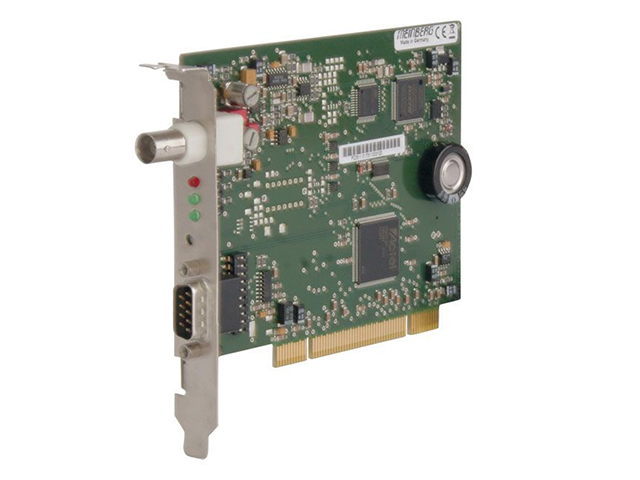
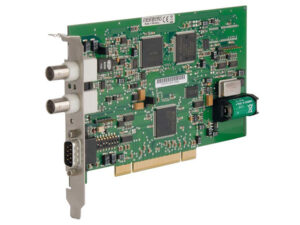
The PCI511 is a DCF77 radio clock for Synchronisation of computers with a PCI or PCI-X slot. It receives the longwave radio time signal from the DCF77 sender located near Frankfurt/Main, Germany.
Key Features
PCI LOCAL BUS interface,
3.3V or 5V, 33MHz or 66MHz,
PCI-X compatible
Plug and play
Pulses per second and per minute
RS-232 interface
Receiver status LEDs
Buffered hardware clock
Configurable time zone
Driver software for all popular operating systems
Need help selecting the right solution?
Our technical specialists can help you choose the right product, answer technical questions and provide a quotation.
Technical Specifications
| Operating Temperature | 0 ... 50°C / 32 ... 122°F |
|---|---|
| RoHS | Yes |
| Interface | PCI LOCAL BUS (PCI), PCI-X compatible |
| Backup Battery Type | In case of supply voltage failure the on-board RTC keeps the time based on XTAL for more than 150 hours (buffer capacitor)
Optional: lithium backup battery (life time: 10 years) |
| Board Type | PCI card short |
| Computer Interface | 33MHz- or 66MHz-PCI BUS (PCI-X) 32 Bit/3.3V or 5V card slot |
| Data Format of Interfaces | Baudrate: 300, 600, 1200, 2400, 4800, 9600 baud
Framing: 7E2, 8N1, 8E1, 8N2 Output string: 32 ASCII characters with date, time and status information |
| Electrical Connectors | 9 pin sub D male connector BNC female connector |
| Further Information | The PCI511 has been designed for the reception of the DCF77 signal, the transfer of the time information to a computer with PCI (PCI-X) bus interface and the translation of the received codes into a serial telegram.
Because the radio clock PCI511 is composed as an universal board for computers with PCI bus, operation within 3.3V and 5V systems is possible. The drivers package for Windows contains a time adjustment service which runs in the background and adjusts the Windows system time continuously and smoothly. A monitor program is also included which lets the user check the status of the device and the time adjustment service, and can be used to modify configurable parameters, if run with administrator rights. The driver packages for Linux and FreeBSD contain a kernel driver which allows the board to be used as a reference time source for the NTP daemon which is shipped with most Unix-like operating systems. This also turns the computer into an NTP time server which can also provide accurate time to NTP clients on the network. Some command line tools can be used to setup configurable parameters and monitor the status of the board. For usage of the card on other operating systems please contact Meinberg support: techsupport@meinberg.de. The device's serial port is not required for operation but can be used to update the card's firmware, or provide another computer with the current time via a serial time string. |
| Pulse Outputs | Pulses per second (RS232/TTL level) and per minute (TTL level), pulse duration: 100 msec, active high |
| Receiver | Narrowband DCF77 quadrature receiver with automatic gain control, bandwidth: approx. 20Hz |
| Reception Control | Multiple check of received time telegram Plausibility control by using two complete time telegrams |
| Relative Humidity | Max. 85% |
| Scope of Supply | Scope of supply includes an active ferrite antenna AI01 and 5m of RG174 coaxial cable with BNC connectors.
Optional: AW02 with RG58 and patch cord, other length of cable |
| Statusbyte | Informations about free running mode, daylight savings time and DST pre-switch announcement, Synchronisation since last reset, GMT/UTC time and validity of the hardware clock data |
| Status Info | RF Signal: Indicated by LED, antenna alignment enhanced by utility program
Free running: Indicated by LED and utility program without RF signal the clock runs on quartz basis with an accuracy of ±1·10-6 (after 24 hours of synchronous operation) Modulation: Indicated by LED and utility program |
| WEEE Status of the Product | This product is handled as a B2B category product. In order to secure a WEEE compliant waste disposal it has to be returned to the manufacturer. Any transportation expenses for returning this product (at its end of life) have to be incurred by the end user, whereas Meinberg will bear the costs for the waste disposal itself. |
Downloads
| Datasheet | Click to view Datasheet (PDF) |
|---|---|
| Manual | Click to view Manual (PDF) |