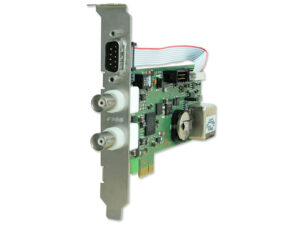
TCR180PEX-EL
IRIG Time Code Receiver for Computers (PCI Express)
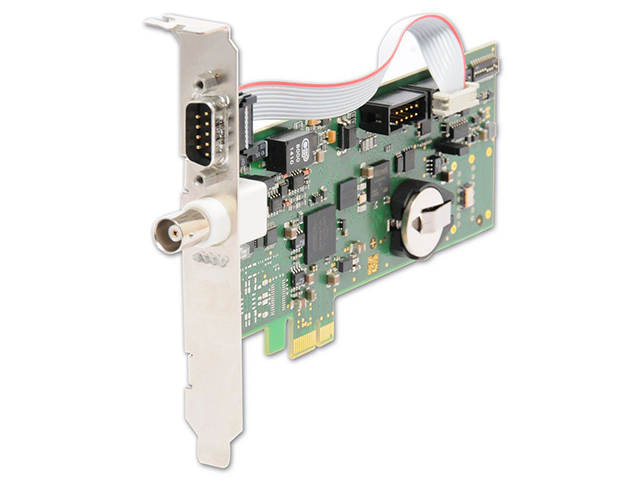
The TCR180PEX-EL receives?IRIG-A/B/G, IEEE 1344, IEEE C37.118 or AFNOR NF S87-500 time codes?and can be used for synchronizing the system time of its host PC.
Key Features
2 time-trigger-inputs
PCI Express Interface
Plug and play
Fix pulse output PPS (TTL or RS232) and PPM (TTL) on D-Sub connector.
Memory Mapped I/O time reads for high access rates
2 RS-232 interfaces
Status LEDs
Reception of time code formats IRIG-A/B/G, IEEE 1344, IEEE C37.118 or AFNOR NF S87-500
Configurable time zone
Driver software for all popular operating systems
Optional optical input for time codes
Need help selecting the right solution?
Our technical specialists can help you choose the right product, answer technical questions and provide a quotation.
Technical Specifications
| Operating Temperature | 0 ... 50°C / 32 ... 122°F |
|---|---|
| RoHS | Yes |
| Interface | Two independent serial RS232 interfaces |
| Accuracy Free Run | ±1·E-6 if the decoder was synchronous for at least 1 h |
| Backup Battery Type | When main power supply fails, hardware clock runs free on quartz basis, life time of lithium battery min. 10 years |
| Board Type | Low Profile card (68,90 x 150 mm) |
| Computer Interface | Single lane (x1) PCI Express (PCIe) Interface
PCI Express r1.0a compatible |
| Data Format of Interfaces | Baud rate: 300 Bd...115200 Bd
Data format: 7E2, 8N1, 8N2, 8E1, 7N2, 7E1, 801 Time telegram: Meinberg Standard-Telegram , SAT, Uni Erlangen (NTP), SPA, RACAL, COMPUTIME, ION or Capture-Telegramm |
| Electrical Connectors | Female BNC-connector for input signal male 9-pole D-Sub connector |
| Frequency Outputs | 10MHz TTL |
| Further Information | The board TCR180PEX-EL has been designed to receive IRIG-A/B/G, IEEE 1344, IEEE C37.118 or AFNOR NF S87-500 time codes.
It is used in applications like data acquisition, standalone computer time Synchronisation (for systems without a network connection or higher accuracy requirements). Receiver: the module provides two input channels for decoding of modulated and unmodulated time codes in IRIG-A/B/G, IEEE 1344, IEEE C37.118 or AFNOR format. The receiver's automatic gain control (AGC) allows the reception of modulated timecode signals within an amplitude range from 600 mVpp to 8 Vpp. In addition, the TCR180PEX-EL provides an optocoupler input for decoding unmodulated codes with TTL- or RS-422 level for example. The board can be delivered with an optical input for unmodulated codes optionally. The decoded date and time can be read via the PCI Express interface and is also transmitted via the board's RS-232 port. A buffered real time clock keeps time and date after power down. The drivers package for Windows contains a time adjustment service which runs in the background and adjusts the Windows system time continuously and smoothly. A monitor program is also included which lets the user check the status of the device and the time adjustment service, and can be used to modify configurable parameters, if run with administrator rights. The driver packages for Linux and FreeBSD contain a kernel driver which allows the board to be used as a reference time source for the NTP daemon which is shipped with most Unix-like operating systems. This also turns the computer into an NTP time server which can also provide accurate time to NTP clients on the network. Some command line tools can be used to setup configurable parameters and monitor the status of the board. For usage of the card on other operating systems please contact Meinberg support: techsupport@meinberg.de. The device's serial port is not required for operation but can be used to update the card's firmware, or provide another computer with the current time via a serial time string. If you are going to use the TCR180PEX-EL in your own applications, please download our software development kit which contains libraries and sample code and shows how to access the card from within your software. All drivers and API sample source code can be downloaded free of charges from our website and we are happy to assist you if you face any difficulties in using the Meinberg driver API in your software development process. |
| Input Signal | Modulated IRIG A/B/G, IEEE1344, IEEE C37.118 or AFNOR NF S87-500 signal, input insulated by transformer, input impedance 50 ohm, 600 ohm or 5 kohm selectable by jumper.
Unmodulated (DC level shift) IRIG A/B/G, IEEE1344, IEEE C37.118 or AFNOR NF S87-500 signal, input insulated by photocoupler. |
| IRIG Time Code Input | IRIG - A002/A132, A003/A133, A006/A136, A007/A137, B002/B122, B003/B123, B006/B126, B007/B127, G002/G142, G006/G146, IEEE 1344, AFNOR NFS 87-500 and IEEE C37.118 (other codes on request) |
| Precision of Timebase | ±750 nsec compared to IRIG reference marker
Required accuracy of time code source: ±100ppm |
| Pulse Outputs | Fix pulse output PPS (TTL or RS232) and PPM (TTL) on D-Sub connector. |
| Relative Humidity | Max. 85% |
| Statusbyte | Information about holdover mode, Synchronisation since last reset and the validity of the RTC data. |
| Status Info | Status info by 4 LED light indicators (2mm light pipes)
Init - blue: while the receiver passes through the initialization phase Data - green: correct time code detected Tele - green: telegramm consistent Fail - red: the internal timing is in holdover mode |
| Time Trigger Inputs | Triggered by falling TTL slope Time of trigger event readable via computer slot or optional second RS232-interface |
| WEEE Status of the Product | This product is handled as a B2B category product. In order to secure a WEEE compliant waste disposal it has to be returned to the manufacturer. Any transportation expenses for returning this product (at its end of life) have to be incurred by the end user, whereas Meinberg will bear the costs for the waste disposal itself. |
Downloads
| Datasheet | Click to view Datasheet (PDF) |
|---|---|
| Manual | Click to view Manual (PDF) |