Meinberg
IMS-GNM Clock
SKU: IMS-GNM Clock
GNSS MULTI BAND Based Time Synchronisation
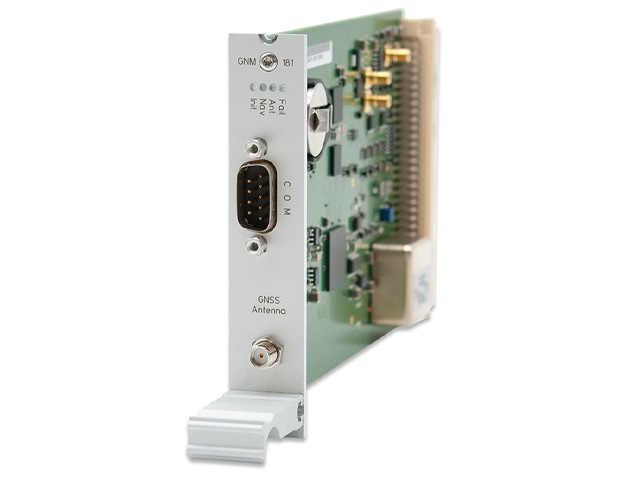
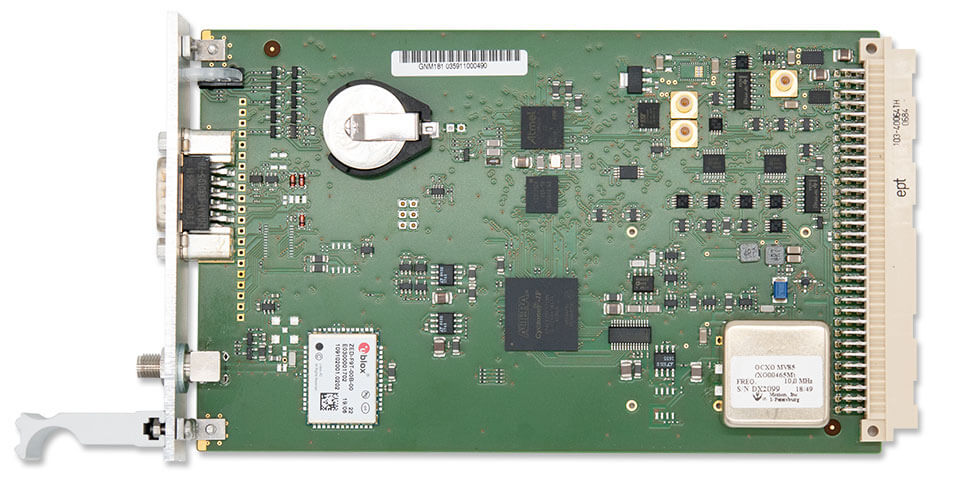
The Meinberg GNM181 multi-band GNSS receiver module with nanosecond-level timing accuracy meets the most stringent 5G timing requirements, is ideal for global deployments due to GPS, BeiDou, Galileo, and GLONASS reception, and is unaffected by ionospheric errors.
Key Features
- RS-232 interface
- Antenna connected with up to 70m of coax cable type Belden H155
- Compatible with IMS-CLK slots
- Oscillator Options: OCXO-SQ, OCXO-MQ, OCXO-HQ, OCXO-DHQ
- Combined 184-channel GPS / Galileo / GLONASS / Beidou receiver
- Synthesizer 1/8 Hz up to 10 MHz (TTL level, sine wave 1.5Veff, open drain)
- 4 programmable TTL outputs and timecode generator (IRIG-B, AFNOR)
Need help selecting the right solution?
Our technical specialists can help you choose the right product, answer technical questions and provide a quotation.
Technical Specifications
| Operating Temperature | 0 ... 50°C / 32 ... 122°F |
|---|---|
| RoHS | Yes |
| Interface | Single serial RS-232 interface |
| Accuracy of Pulse Outputs | Depends on oscillator option: < ±100ns (TCXO) < ±50ns (OCXO SQ, OCXO MQ, OCXO HQ, OCXO DHQ, Rubidium) |
| Backup Battery Type | CR2032 - button cell lithium battery
When main power supply fails, hardware clock runs free on quartz basis, almanac data is stored in RAM Life time of lithium battery min. 10 years |
| Cable Type | Coaxial cable Belden H155 indoor or outdoor usage
Maximum length of antenna cable: 70 meters |
| Current Consumption | +5 V 1,1 A to 1,4 A (depends on oscillator option) |
| Data Format of Interfaces | Baud rate: 300, 600, 1200, 2400, 4800, 9600, 19200 Baud
Data format: 7E1, 7E2, 7N2, 7O1, 7O2, 8E1, 8N1, 8N2, 8O1 Time telegram: Meinberg Standard-Telegram , SAT, Uni Erlangen (NTP), SPA, Sysplex, RACAL, NMEA0183 (RMC,GGA,ZDA), Meinberg GPS, COMPUTIME, ION oder Capture-Telegramm |
| Electrical Connectors | 96-pin VG-rail DIN 41612 |
| Frequency Outputs | Accuracy depends on oscillator (standard: OCXO-SQ), see oscillator list |
| Further Information | The module provides differential timing mode for highly accurate local timing and built-in security for highest robustness against malicious attacks. The variety of inputs/outputs makes this combined GNSS receiver (GPS, GLONASS, Galileo & Beidou) the first choice for a broad range of applications, including time and frequency Synchronisation tasks and the measurement of asynchronous time events.
The frequency locking of the master oscillator to the GNSS system enables the GNM system to generate fixed and optionally programmable standard frequencies with high accuracy and stability. Various oscillator options allow the cost efficient implementation of different requirements concerning the accuracy of the outputs. The pulse generator of the GNM multi band receiver generates pulses per second and per minute. As an option four programmable outputs are available. The pulses are Synchronised to UTC-second. Up to four serial interfaces are available for sending timestrings. These ASCII-telegrams include information regarding time, date and status of the GNM-receiver. The module provides two inputs for measurement of asynchronous time events. These capture events can be read via a serial interface. The parameter setting of the module is done by a monitor software. |
| Generated Time Codes | IRIG B002: 100pps, DCLS signal, no carrier, BCD time of year
IRIG B122: 100pps, AM sine wave signal, 1 kHz carrier, BCD time of year IRIG B003: 100pps, DCLS signal, no carrier, BCD time of year, SBS time of day IRIG B123: 100pps, AM sine wave signal, 1kHz carrier, BCD time of year, SBS time of day IRIG B006: 100 pps, DCLS Signal, no carrier, BCD time-of-year, Year IRIG B126: 100 pps, AM sine wave signal, 1 kHz carrier frequency, BCD time-of-year, Year IRIG B007: 100 pps, DCLS Signal, no carrier, BCD time-of-year, Year, SBS time-of-day IRIG B127: 100 pps, AM sine wave signal, 1 kHz carrier frequency, BCD time-of-year, Year, SBS time-of-day IEEE1344: Code according to IEEE1344-1995, 100pps, AM sine wave signal, 1kHz carrier, BCD time of year, SBS time of day, IEEE1344 expansion for date, time zone, daylight saving and leap second in Control Functions Segment C37.118: Like IEEE1344 - with turned sign bit for UTC-Offset AFNOR: Code according to NFS-87500, 100pps, AM sine wave signal, 1kHz carrier, BCD time of year, complete date, SBS time of day |
| Power Supply Maximum Power Range | +5V DC |
| Pulse Outputs | Pulse per second (PPS) and pulse per minute (PPM). TTL level, pulse width: 200msec |
| Receiver | 184 channel GPS / Galileo / GLONASS / Beidou receiver
Supported GNSS and Signals: GPS: L1C/A (1575.42 MHz) L2C (1227.60 MHz) GLONASS: L1OF (1602 MHz + k*562.5 kHz L2OF (1246 MHz + k*437.5 kHz k = -7,..., 5, 6 Galileo: E1-B/C (1575.42 MHz) E5b (1207.140 MHz) Beidou: B1I (1561.098 MHz) B2I (1207.140 MHz) Antenna connector: SMA |
| Relative Humidity | Max. 85% |
| Scope of Supply | The system will be delivered inclusive GNSS MULTI BAND ANTENNA, mounting kit and 20 m coax-cable (Belden H155). |
| Status Info | Status info by 4 LED light indicators (2mm light pipes)
|
| Switch Outputs | Four TTL outputs can configured independently for the following modes:
- free programmable cyclic or fixed impulses - timecode - timer mode; three 'ON'- and three 'OFF'-states can be setup per day The switch states can be inverted for all three outputs, the impulse lengths are configurable. The impulse output can be configured for all channels together to 'always' or 'ifsync'. |
| Synchronisation Time | < 1 minute in normal operation mode,
approx. 1 minute after a cold start (12 minutes in GPS-only mode) |
| Type of Antenna | GNSS MULTI BAND Antenna:
The GNSS MULTI BAND Antenna provides multi GPS L1/L2/L5, GLONASS G1/G2/G3, Beidou B1/B2, Galileo E1/E5a+b plus L-band correction services coverage and is especially designed for precision multi frequency positioning. |
| WEEE Status of the Product | This product is handled as a B2B category product. In order to secure a WEEE compliant waste disposal it has to be returned to the manufacturer. Any transportation expenses for returning this product (at its end of life) have to be incurred by the end user, whereas Meinberg will bear the costs for the waste disposal itself. |
Downloads
| Datasheet | Click to view Datasheet (PDF) |
|---|---|
| Manual | Click to view Manual (PDF) |