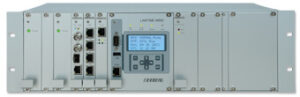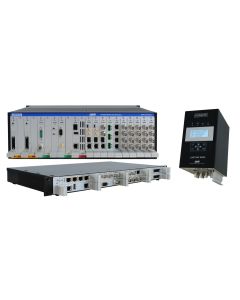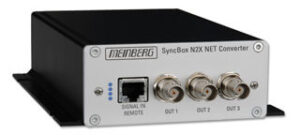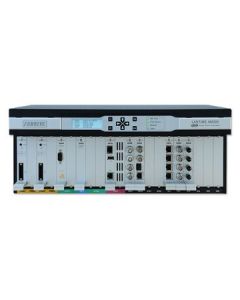
IMS – LANTIME M2000S
Modular Time and Frequency Synchronisation Platform in 2U Rackmount Housing
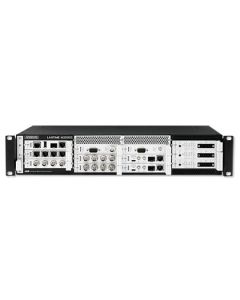
Versatile and Modular Solution for Time and Frequency Synchronisation Applications in a Compact 2RU Chassis
The new LANTIME M2000S is a field-upgradeable and extremely flexible system that covers your Synchronisation needs – today and in the future. Upgrading to more outputs, new connector and signal types and protocols is easier than ever with Meinbergs Intelligent Modular Synchronisation platform (IMS).
The IMS LANTIME S models are an alternative for application environments where a display with function keys is not required for onsite configuration. This allows the S housing variants to be installed in racks which are only accessible from one side.
The LANTIME M2000S chassis can be installed in 19 inch racks as well as 21 inch racks (with an adapter). The reduced mounting depth of the S chassis enables you to mount the system in 300mm ETSI racks. All connections and control elements are placed on one side, allowing to mount this chassis on a wall or inside a rack that is only accessible from one side. The base M2000S chassis comes with three power supply slots, two clock module slots, a CPU slot and six slots for additional input and output modules. Adding a second clock module will turn the M2000S into a fully redundant solution. Up to three power supplies, that can be installed, offer a high level of protection against the failure of one or more power sources and power supply failures. Both wide range AC and DC power supply models can be mixed and matched as required.
Key Features
- Six free configurable IO slots with low space requirement. - These slots can be used, for example, for 24 outputs (PPS, 10 MHz ...).
- Synchronisation of NTP and SNTP compatible clients
- Web-based status and configuration interface
- IEEE 1588 PTP Grandmaster / Slave (optional)
- E1 / T1 Input / Output Options
- Up to 6 PTP (IEEE 1588-2008) modules
- Optional redundant power supply and receiver configuration (e.g. GPS / GLONASS combination).
- Also available with DHQ oscillators
- Hot Plug
- Arbitrary combinations of modules
- Three available slots for AC/DC or DC power supplies
- Meinberg's LANTIME time server is available with a variety of additional output options: IRIG Time Code, frequency synthesizer and programmable pulse outputs illustrate some of the many expansion options for your NTP server
- Up to 24 additional LAN ports
Need help selecting the right solution?
Our technical specialists can help you choose the right product, answer technical questions and provide a quotation.
Technical Specifications
| Operating Temperature | 0 ... 50°C / 32 ... 122°F |
|---|---|
| RoHS | Yes |
| CPU |
|
| Accuracy of Pulse Outputs | < ±50ns (OCXO SQ, OCXO MQ, OCXO HQ, OCXO DHQ) |
| Daytime Protocol (DAYTIME) | Daytime Protocol (RFC 867) |
| Firmware Updates | Firmware is field-upgradeable, updates can be installed directly at the unit or via a remote network connection. Software updates are provided free of charge, for the lifetime of your Meinberg product. |
| Frequency Outputs | Accuracy depends on oscillator (standard: OCXO-SQ) |
| Further Information | The possibility to add input and output modules as well as specialized communication cards for NTP and PTP/IEEE1588 network Synchronisation (including Synchronous Ethernet support) and remote management ensures that a LANTIME M2000S will fulfil all your Synchronisation requirements and the scalability and flexibility of the IMS platform concept enables it to cope with the changing demands of your critical applications.
All modules support hot plugging, allowing to replace faulty modules or add new capabilities to the system with zero downtime for unaffected modules and functions. Includes: High-End NTP Network Time Server for your Network With up to 25,000 NTP requests per second (depending on the installed CPU module), the system is able to provide time for hundreds and thousands of NTP clients. The LANTIME management CPU module supports the following protocols: NTP / SNTP (v2, v3, v4), PRP (IEC 62439-3), HTTP (S), SSH, Telnet, SNMP (v1, v2, v3), FTP, SFTP, DHCP/DHCPv6. For each system, up to 99 logical network interfaces are available (99 IPv4 and 99 IPv6 addresses, each logical interface can be assigned to one VLAN ID). Enterprise-grade features such as IPv6/Dual Stack support, IEEE 802.1Q VLAN support, LACP/high availability bonding as well as DSCP and IEEE802.1p QoS/CoS traffic prioritization ensure that this product can be installed and operated in almost every critical environment: a financial data centre; an electrical substation; an NGN telecommunication network; a digital broadcasting infrastructure ; air traffic control systems and many other environments. Scalable Synchronisation Solution All modules are hot-pluggable and can be configured via a central web interface or a CLI. An almost endless number of combinations of input and output modules handles almost any Synchronisation task and allows the system to fit into many different roles. The field-upgradeable and therefore highly scalable and flexible IMS concept will grow with your demands. New technologies can be easily integrated into your existing devices as soon as a corresponding module is available, supporting a new connector, signal type or protocol. This protects your investments as it removes the requirement to replace existing devices or add complete new systems when your sync requirements change. Flexible Synchronisation References: IMS-MRI: Standard reference input cards supporting a number of different input signals like 1PPS, 10 MHz, IRIG DCLS, IRIG AM IMS-ESI: Extended reference inputs for Synchronisation sources like E1/T1 framed and unframed signals Both of these slot types (MRI / ESI) can alternatively accept I/O cards and therefore can be used to add output modules or network interfaces, resulting in a maximum of six output modules per chassis in combination with the remaining two I/O slots. Due to the hot-plug capabilities of the IMS platform it is possible to add additional modules or replace modules with zero downtime and no negative impact on the system and its modules. Power supply failures and a large number of additional Synchronisation related alarms can be communicated using several different protocols, for example mail/SMTP messages, SNMP traps, SYSLOG messages, or alarm relay cards. |
| Hypertext Transfer Protocol (HTTP) | HTTP/HTTPS (RC 2616) |
| IEC 61850 | Synchronisation of IEC 61850 compliant devices by using SNTP |
| Internet Protocol (IP) | IP v4, IP v6 |
| Network Interface |
|
| Network Autoconfiguration Support |
|
| Network Interface |
|
| Network Protocols OSI Layer 4 Transport Layer | TCP, UDP |
| Network Protocols OSI Layer 7 Application Layer | TELNET, FTP, SSH (incl. SFTP, SCP), HTTP, HTTPS, SYSLOG, SNMP |
| Network Time Protocol (NTP) |
|
| Operating System of the SBC | GNU/Linux 4.x |
| Parallel Redundancy Protocol (PRP) | PRP (IEC 62439-3) |
| Power Supply Maximum Power Range |
|
| Reference Options |
|
| Relative Humidity | Max. 85% |
| Scope of Supply | The scope of delivery includes a CAB-CONSOLE-RJ45 cable for initial start of operation, documentation and software on USB stick. |
| Secure Shell SSH | SSH v1.3, SSH v1.5, SSH v2 (OpenSSH) |
| Simple Network Management Protocol (SNMP) | SNMPv1 (RFC 1157), SNMPv2c (RFC 1901-1908), SNMP v3 (RFC 3411-3418) |
| Technical Support | Meinberg offers free lifetime technical support via telephone or e-mail. |
| Telnet | Telnet (RFC 854-RFC 861) |
| Time Protocol (TIME) | Time Protocol (RFC 868) |
| WEEE Status of the Product | B2B. Return to manufacturer |
Downloads
| Datasheet | Click to view Datasheet (PDF) |
|---|---|
| Manual | Click to view Manual (PDF) |